Software-in-the-Loop with Neural-LQR Controller
Files: examples/advanced/02_sil_ai_controller/
What this example shows
A two-process SIL (Software-in-the-Loop) simulation of a 2-DOF mass-spring-damper where a PyTorch MLP — initialized with LQR optimal gains — drives the physical plant running in a separate process via zero-copy shared memory.
| Process | File | Role |
|---|---|---|
| Plant | 02a_sil_plant.py | Runs the 2-DOF physics model in real time |
| Controller | 02b_sil_ai_controller.py | PyTorch Neural-LQR + live scientific plot |
Physical model — 2-DOF mass-spring-damper
  [k]         [k]
──/\/\/──[m₁]──/\/\/──[m₂]──→ F(t)
  [c]                  [c]
State vector — positions and velocities of both masses. Input: force applied to .
Built with StateEquations — no manual index management:
from synapsys.utils import StateEquations

m, c, k = 1.0, 0.1, 2.0

eqs = (
    StateEquations(states=["x1", "x2", "v1", "v2"], inputs=["F"])
    .eq("x1", v1=1)
    .eq("x2", v2=1)
    .eq("v1", x1=-2*k/m, x2=k/m,  v1=-c/m)
    .eq("v2", x1=k/m,  x2=-2*k/m, v2=-c/m, F=k/m)
)
Architecture
Neural-LQR controller
Why LQR initialisation?
LQR solves the infinite-horizon optimal control problem:
where is obtained from the Algebraic Riccati Equation and is the DC feedforward gain for setpoint tracking.
The MLP is initialised so that its output layer directly implements . This:
- Guarantees stability at initialisation — closed-loop poles are analytically placed
- Provides a physically meaningful starting point for RL fine-tuning
- Demonstrates physics-informed neural network design for control applications
from synapsys.algorithms import lqr
import torch.nn as nn

K, _ = lqr(eqs.A, eqs.B,
           Q=np.diag([1.0, 10.0, 0.5, 1.0]),
           R=np.array([[1.0]]))
# K = [−0.382, 2.227, 0.420, 1.747]

class NeuralLQR(nn.Module):
    def __init__(self, K, Nbar):
        super().__init__()
        self.Nbar = Nbar
        self.net = nn.Sequential(
            nn.Linear(4, 32), nn.Tanh(),
            nn.Linear(32, 16), nn.Tanh(),
            nn.Linear(16, 1),
        )
        with torch.no_grad():
            nn.init.xavier_uniform_(self.net[0].weight)
            nn.init.xavier_uniform_(self.net[2].weight)
            # Physics-informed: output layer ← LQR gains
            self.net[4].weight.data = torch.tensor(-K.reshape(1, -1))
            self.net[4].bias.data.zero_()

    def forward(self, x):
        return self.net(x) + self.Nbar * X2_REF
Inference in the control loop
def control_law(state: np.ndarray) -> np.ndarray:
    with torch.no_grad():
        t_in = torch.tensor(state, dtype=torch.float32).unsqueeze(0)
        u = float(model(t_in).squeeze())   # forward pass < 0.1 ms
    return np.clip(np.array([u]), -U_LIMIT, U_LIMIT)
numpy (4,) → torch.Tensor (1,4) → MLP forward → torch scalar → numpy (1,)
torch.no_grad() disables autograd — no gradient tracking during inference.
Real-time scientific plot
The agent runs in a background thread (blocking=False). The main thread drives a 4-panel FuncAnimation plot:
| Panel | Signal | Info |
|---|---|---|
| Position (top) | , | Tracks setpoint m |
| Velocities (mid-left) | , | Damping dynamics |
| Control force (mid-right) | Neural-LQR output, ±20 N saturation | |
| Phase portrait (bottom) | trajectory | Convergence to equilibrium |
Data is captured into collections.deque(maxlen=600) buffers (6 s window). deque.append() is thread-safe under the GIL — no explicit lock needed for reading the animation.
Result
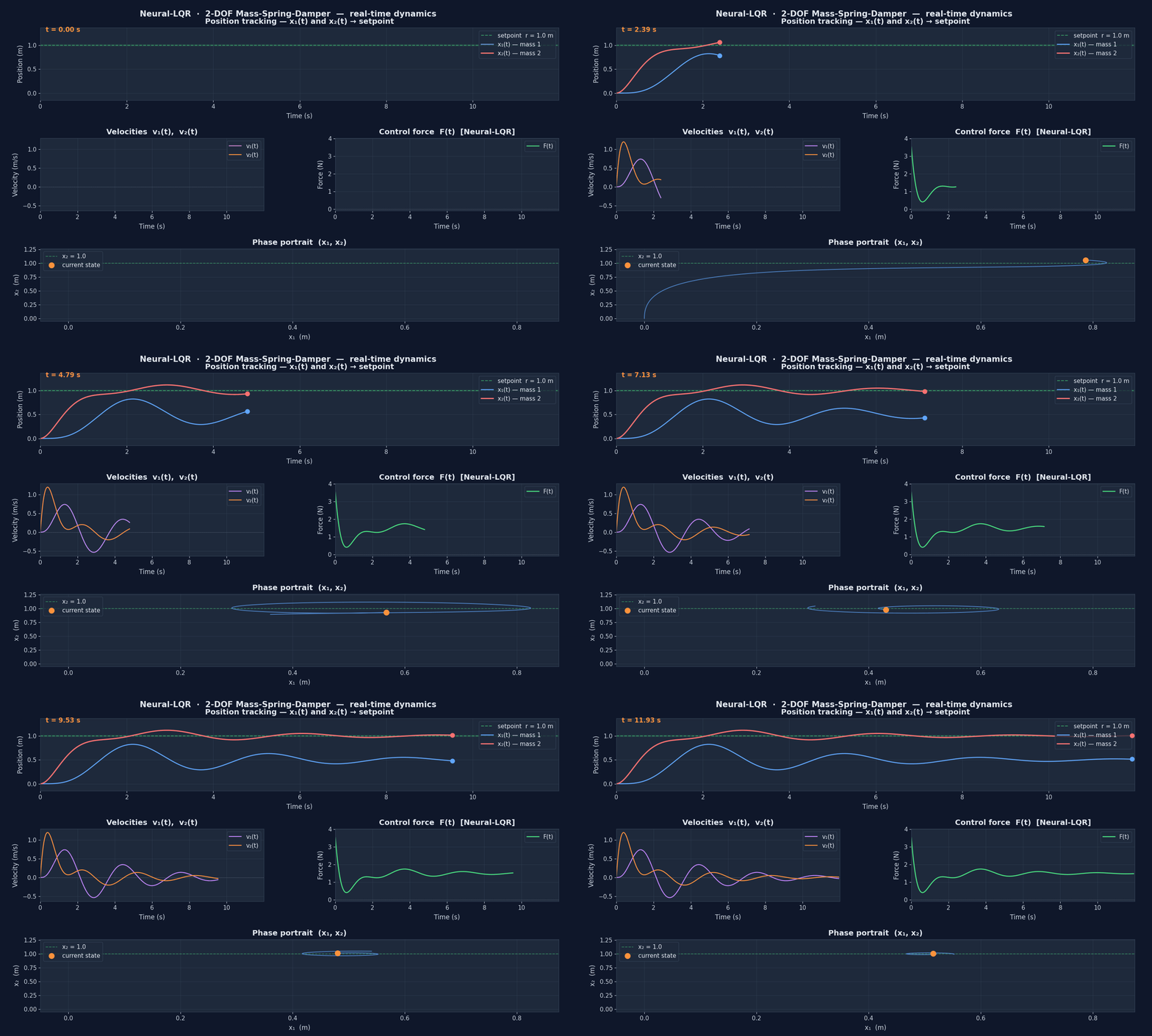
converges to the setpoint m with minimal overshoot. The phase portrait shows the trajectory spiralling into the equilibrium point — the hallmark of an underdamped stable system driven by an optimal controller.
How to run
# Terminal 1 — start the plant first
uv run python examples/advanced/02_sil_ai_controller/02a_sil_plant.py

# Terminal 2 — connect the Neural-LQR controller
uv run python examples/advanced/02_sil_ai_controller/02b_sil_ai_controller.py
A matplotlib window opens with 4 live panels. Close the window to stop.
Replace the NeuralLQR forward pass with any nn.Module trained by PPO, SAC or DDPG. The ControllerAgent callback signature (np.ndarray → np.ndarray) remains identical — only the model weights change.
Change X2_REF at runtime, or implement a time-varying reference inside control_law(). The MLP's hidden layers can learn non-linear compensation beyond what the linear LQR initialisation provides.