From Model to Hardware: MIL → SIL → HIL in Three Steps

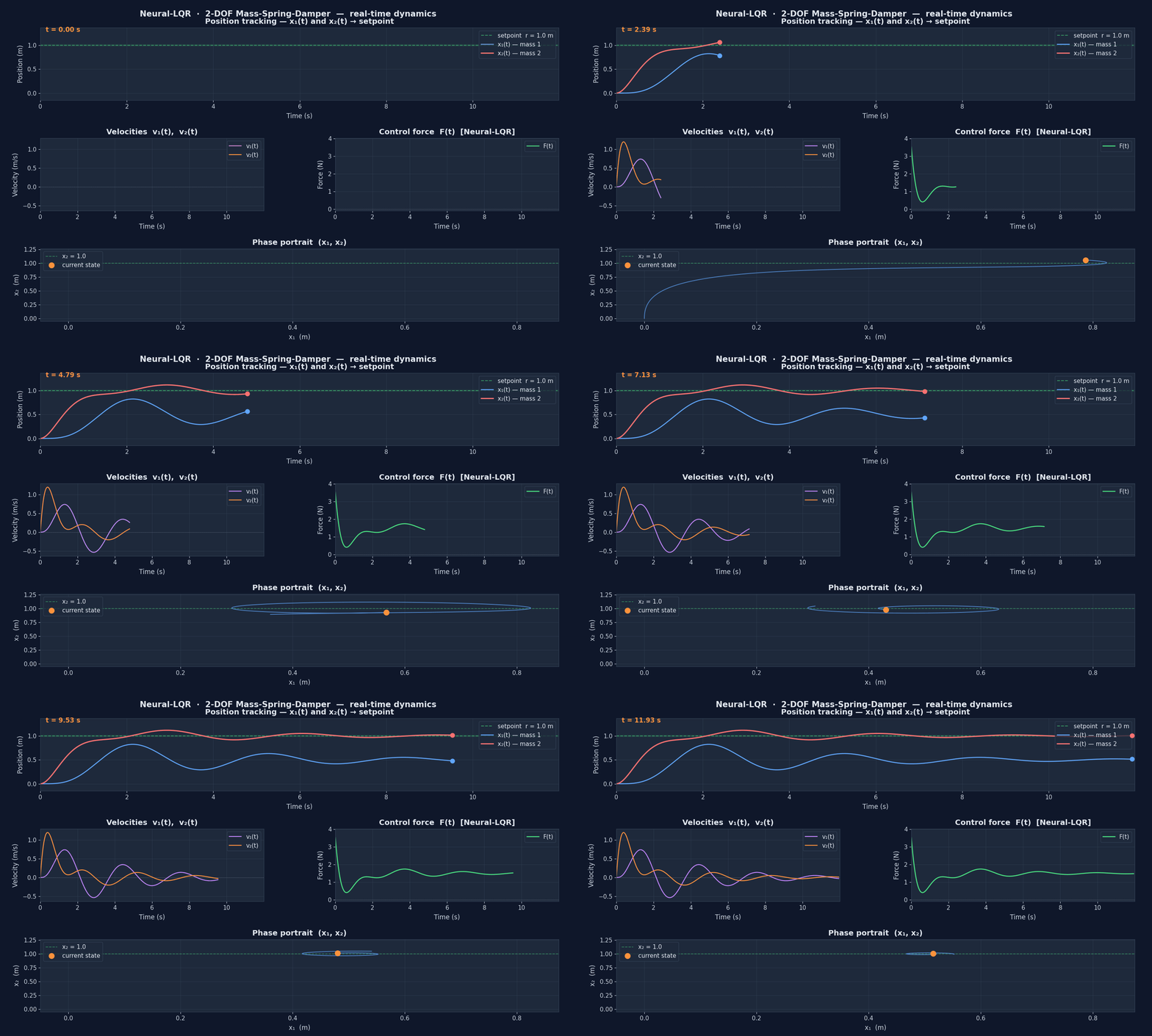
MIL → SIL → HIL is the standard V-model progression for embedded control: simulate everything first, then replace the plant model with real hardware one layer at a time. In most frameworks this requires rewriting large parts of the control loop. In Synapsys the transition is a one-line swap because the transport layer is fully abstracted from the algorithm.
The three stages
| Stage | Plant | Controller | Transport | Purpose |
|---|---|---|---|---|
| MIL — Model-in-the-Loop | Simulated (StateSpace) | Algorithm code | Shared memory | Rapid iteration, unit tests |
| SIL — Software-in-the-Loop | Simulated | Compiled binary / external process | ZeroMQ | Integration tests, latency profiling |
| HIL — Hardware-in-the-Loop | Real device | Algorithm code or MCU firmware | HardwareInterface | Acceptance testing on real plant |
The Synapsys abstraction that makes this work:
Agent ──► TransportStrategy (read / write)
              │
              ├── SharedMemoryTransport   ← MIL
              ├── ZMQTransport            ← SIL
              └── HardwareInterface       ← HIL
The Agent never calls transport directly — it calls _read() / _write().
Swap the transport, leave the agent unchanged.
Stage 1 — MIL: everything in one process
from synapsys.api import ss, c2d
from synapsys.agents import PlantAgent, ControllerAgent, SyncEngine, SyncMode
from synapsys.algorithms import PID
from synapsys.transport import SharedMemoryTransport
import numpy as np

plant_d = c2d(ss([[-1]], [[1]], [[1]], [[0]]), dt=0.01)

pid = PID(Kp=4.0, Ki=1.0, dt=0.01)

def law(y: np.ndarray) -> np.ndarray:
    return np.array([pid.compute(setpoint=3.0, measurement=y[0])])

with SharedMemoryTransport("demo", {"y": 1, "u": 1}, create=True) as bus:
    bus.write("y", np.zeros(1))
    bus.write("u", np.zeros(1))
    sync = SyncEngine(SyncMode.LOCK_STEP, dt=0.01)
    PlantAgent("plant", plant_d, bus, sync).start(blocking=False)
    ControllerAgent("ctrl", law, bus, sync).start(blocking=True)
All in one script. Fast, deterministic, easy to unit-test.
Stage 2 — SIL: two processes over ZeroMQ
Split plant and controller into separate processes. The controller algorithm does not change at all:
- plant_process.py
- controller_process.py
from synapsys.api import ss, c2d
from synapsys.agents import PlantAgent, SyncEngine, SyncMode
from synapsys.transport import ZMQTransport

plant_d = c2d(ss([[-1]], [[1]], [[1]], [[0]]), dt=0.01)

pub = ZMQTransport("tcp://*:5555",      mode="pub")   # publish y
sub = ZMQTransport("tcp://localhost:5556", mode="sub") # subscribe u

# ZMQTransport wraps both sockets in a single bus-like interface
# (see ZMQReqRepTransport for request-reply pattern)
sync = SyncEngine(SyncMode.WALL_CLOCK, dt=0.01)
PlantAgent("plant", plant_d, pub, sync, sub_transport=sub).start(blocking=True)
from synapsys.agents import ControllerAgent, SyncEngine, SyncMode
from synapsys.algorithms import PID
from synapsys.transport import ZMQTransport
import numpy as np

pid = PID(Kp=4.0, Ki=1.0, dt=0.01)

def law(y: np.ndarray) -> np.ndarray:
    return np.array([pid.compute(setpoint=3.0, measurement=y[0])])

sub = ZMQTransport("tcp://localhost:5555", mode="sub")  # subscribe y
pub = ZMQTransport("tcp://*:5556",         mode="pub")  # publish u

sync = SyncEngine(SyncMode.WALL_CLOCK, dt=0.01)
ControllerAgent("ctrl", law, sub, sync, pub_transport=pub).start(blocking=True)
The law function is identical to the MIL version. Only the transport changed.
Stage 3 — HIL: real hardware
Replace the StateSpace plant with a HardwareInterface implementation for your
device. Everything else — the PID, the sync engine, the ZMQ transport — stays:
from synapsys.agents import HardwareAgent, SyncEngine, SyncMode
from synapsys.hw import HardwareInterface
from synapsys.transport import ZMQTransport
import numpy as np

class MyDAQInterface(HardwareInterface):
    """Wrapper around a USB DAQ card (e.g. NI-DAQ, Arduino, STM32)."""

    def __init__(self):
        super().__init__(n_inputs=1, n_outputs=1)
        # self.daq = ...  initialise your hardware SDK here

    def read_outputs(self, timeout_ms: float = 100.0) -> np.ndarray:
        # return np.array([self.daq.read_channel(0)])
        return np.array([0.0])   # stub

    def write_inputs(self, u: np.ndarray, timeout_ms: float = 100.0) -> None:
        # self.daq.write_channel(0, float(u[0]))
        pass


# Drop-in replacement: HardwareAgent instead of PlantAgent
sub = ZMQTransport("tcp://localhost:5556", mode="sub")
pub = ZMQTransport("tcp://*:5555",         mode="pub")
sync = SyncEngine(SyncMode.WALL_CLOCK, dt=0.01)

HardwareAgent("hw", MyDAQInterface(), pub, sync, sub_transport=sub).start(blocking=True)
The controller process does not change. The swap is surgical.
Common pitfalls
Timing jitter in SIL
WALL_CLOCK sync relies on time.sleep() precision. On Linux with a standard
kernel, expect ±0.5 ms jitter at 100 Hz. For tighter requirements:
# Use LOCK_STEP for in-process simulation (no timing issues)
sync = SyncEngine(SyncMode.LOCK_STEP, dt=0.01)

# Use WALL_CLOCK for cross-process / HIL
sync = SyncEngine(SyncMode.WALL_CLOCK, dt=0.01)
Initial condition mismatch
Always initialise shared channels before starting agents:
bus.write("y", np.zeros(1))   # ← do this
bus.write("u", np.zeros(1))   # ← do this
PlantAgent(...).start(blocking=False)
ControllerAgent(...).start(blocking=True)
A controller that reads before the first plant write will get stale zeros — fine for ZOH semantics, but worth being explicit.
Summary
The MIL → SIL → HIL transition with Synapsys is:
- MIL:
SharedMemoryTransport+PlantAgent+ControllerAgent - SIL: swap to
ZMQTransport, split into two processes - HIL: swap
PlantAgentforHardwareAgent(MyDAQInterface(), ...)
The control algorithm never changes. The law function you wrote on day one
runs unchanged on the real hardware.
See the full SIL example at
examples/advanced/02_sil_ai_controller/.